How Changing Borders Reshape Film Archives
Changing borders reshape film archives by moving records between institutions and labels. Trace a film’s archival route to explain why catalogs differ.
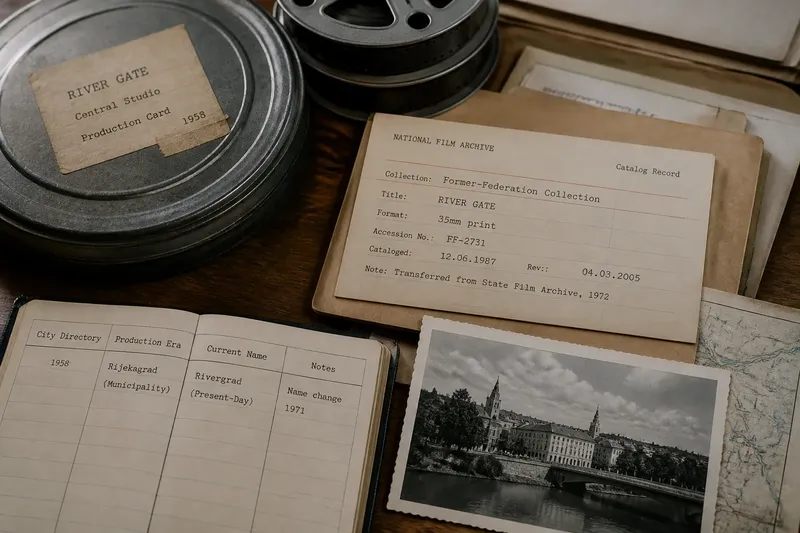
Why does the same older film appear under different countries in different catalogs? Changing borders reshape film archives: records may pass to new institutions, while later catalogers organize them around present-day states, former governments, or regional collections.
Follow the record’s route rather than treating a catalog label as a final verdict. The useful question is not only where a film was made, but how its paperwork, prints, and descriptions came to be held and named.
Follow the record
Start with the catalog entry and note its institution, collection name, and stated classification. Then look for a production file, accession note, or catalog history that explains how the material reached that collection. These details can reveal whether a label reflects original paperwork, an inherited filing system, or a later editorial choice.
Keep the evidence types distinct. A production document may name a studio or government agency; an accession record may show when an archive received a print; a current catalog may assign a national category for browsing. Each answers a different question.
Useful places to check include national film archives, municipal archives, library catalogs, festival databases, and digitized finding aids. Search variant spellings of a title and place-name, including historical forms, because catalog records may preserve the terminology used when an item was first registered.
Read catalog labels
A national label can help someone find a film without explaining its full history. One archive may retain the classification of the state that assembled its collection. Another may use the current country associated with the production city. A third may organize the title by language or a regional collection.
When labels differ, record the wording and the institution that uses it. Avoid claiming that one catalog is wrong unless you can identify a specific factual error. Often the difference comes from distinct cataloging purposes rather than conflicting evidence about the film itself.
Not every label needs a long explanation. If your description has room for only one, choose the category that best serves the reader’s task, then add a brief note when the historical distinction changes how the film can be understood or located.
Trace archival changes
When political authority changes, institutions may be reorganized and collections may be transferred, divided, or renamed. Records can remain in their original language, acquire new catalog terms, or be described through a successor institution’s system. Do not assume that a current archive’s location tells you where a film was first filed.
For each relevant source, note:
- Catalog wording: If the entry names a country or region, compare that term with the collection’s scope; if they differ, report both rather than silently substituting one.
- Record date: If the description has a date or revision history, distinguish it from the production date; if none appears, treat the catalog’s wording as undated rather than contemporaneous.
- Collection history: If an accession note names a transfer or predecessor institution, include that route when it explains the present location; if it gives no route, do not infer one.
- Place-name form: If a record uses a historical name, pair it with the current name when readers need to locate the place; if the forms cannot be confidently matched, preserve the source wording and flag the uncertainty.
- Language of description: If a catalog uses a regional or minority-language term, retain it where relevant and explain it plainly; if the term is unclear, seek a reliable catalog note before translating it.
- Conflicting entries: If two institutions classify the title differently, name each institution and its wording; if one entry has clearer supporting documentation, give that evidence greater weight while still noting the other classification.
These checks help distinguish an archive’s filing practice from a claim about cultural ownership. They also make your description easier to update if a catalog record changes.
Build a careful note
Use a sentence structure that separates what the records say from what you infer: identify the source, state its wording, then explain the historical context. For example, “The city archive catalogs the print under its former federation collection; a later national database lists the production city under its current state.” That phrasing reports both labels without pretending they mean the same thing.
Say you are preparing a program note for an invented film called River Gate. Your starting materials are a fictional production card naming a central studio, a fictional archive catalog placing the surviving print in a former-federation collection, and a fictional city directory showing that the production-era city name differs from its current name. First, quote the studio and the catalog’s collection label separately. Next, pair the historical city name with the current one, marking the latter as a present-day locator. Finally, write: “Produced by the central studio, River Gate is cataloged in the former-federation collection; its production-era city is now listed under a different name.” The result identifies the available evidence and the catalog’s route without assigning the film a single national identity that the records do not establish.
What is not worth the effort is forcing every catalog into one supposedly definitive national category. A search label can be useful for retrieval and still leave the archive’s history unexplained.
Which archive label fits?
Does a current catalog label prove where a film belongs?
No. It shows how that institution currently organizes or describes the item. Check the collection history and supporting records before treating the label as evidence of an original classification.
Should I preserve an old place-name?
Preserve it when it appears in production-era records or matters to the archive’s history. Add the current name as a locator when useful, and make clear which name comes from which period.
What if two archives disagree?
State each institution’s label and look for differences in collection scope, catalog dates, or documentation. If the available records do not settle the discrepancy, say so rather than choosing a winner without grounds.
Can a collection name explain a film’s history?
It can explain how the archive groups or inherited the item, but it does not by itself establish the film’s production context or cultural affiliation. Use it as evidence about the record’s archival path.
Describe the route
Changing borders reshape film archives by changing the institutions and classification systems through which records travel. In a short description, name the source and its label, add the historical detail that clarifies the difference, and leave unresolved claims open. That gives readers a clear route through the catalog without mistaking its filing system for the whole history.