What a National Cinema Can Tell Us, and What It Cannot
National cinema helps organize film history by country, but a careful viewing approach keeps one film from standing in for a whole population.

What can national cinema tell you about a film, and where does the label stop helping? It can point toward the institutions, languages, funding systems, and public debates that shaped a work. It cannot make one director, genre, or story representative of everyone in a country. Treat the label as a useful starting place, then ask what it reveals about this particular film.
Use the label as a map
A national cinema is a way of grouping films by their relationships to a country: where they were made, who supported them, which audiences they addressed, or what cultural institutions shaped them. Those connections can be strong, but they do not always line up neatly. A production may involve a local studio, overseas financing, a director working abroad, and performers speaking several languages.
For a first pass, note what the national label helps you locate. Does it direct you to a film school, a state studio, a local distributor, or a public debate? Does it help explain why a particular story reached theaters or remained difficult to see? These questions make the category concrete rather than ceremonial.
Then check whether the label obscures a more relevant connection. A film’s production company, language, region, intended audience, or route into circulation may explain more than its passport-like classification. Keep the national category when it clarifies the work; qualify it when another connection carries more weight.
Separate the evidence
It helps to distinguish what you can observe in the film from what you know about its production and reception. A scene set in a recognizable city is evidence of a chosen setting, not proof that the film speaks for everyone who lives there. A character’s accent or family customs may be significant, but they remain part of a specific story.
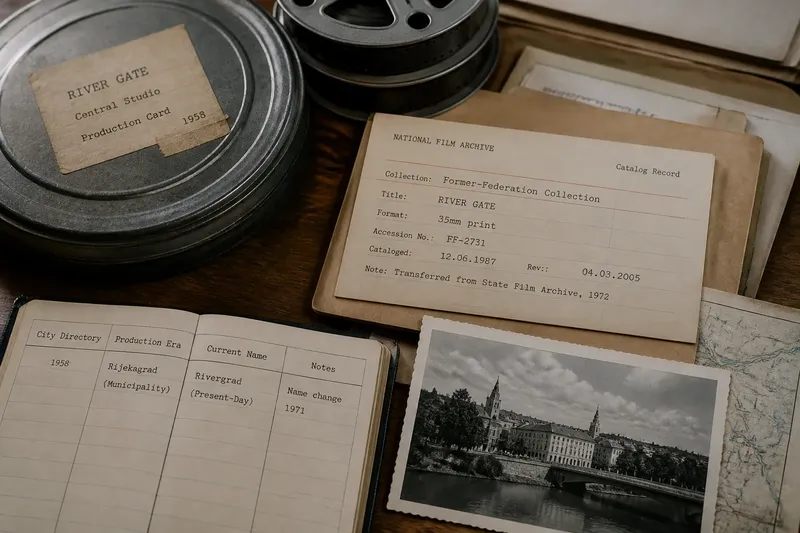
Production context adds another layer. Look at the opening or closing credits for companies, studios, public agencies, and partners. A catalog entry or program note can help identify a film’s country of production, while the film itself can show which languages and places it foregrounds. Keep those claims separate: a production credit is not the same thing as a national viewpoint.
Reception belongs to a third layer. A film may be praised at home, marketed abroad as a national discovery, or barely circulate beyond a small audience. Those are different experiences, and none automatically establishes what a whole population thinks. If you have access to local reviews or contemporary program notes, use them to describe a particular response, not to invent a consensus.
Notice the missing voices
Every national category has edges. Some films are easier to preserve, distribute, and discuss than others. A canon built around widely circulated features may leave out regional production, documentary work, experimental shorts, community screenings, or films made outside recognized institutions.
That absence changes the story a viewer encounters. If a survey presents a country’s cinema through a small group of internationally visible directors, ask what kinds of work the selection makes hard to see. The point is not to reject the films on the list. It is to notice that a list is a selection, shaped by access and editorial choices.
Language needs similar care. A film may use a national language, a regional language, a minority language, or several at once. The language heard on screen does not by itself settle the film’s national identity, and a single label can flatten the differences among its speakers. Check the film’s own language information where available, and describe what you hear without treating one voice as the voice of a country.
Compare without flattening
Comparison is most useful when the question is specific. Instead of asking which film is more “national,” compare how two works handle a shared subject: a rural setting, a workplace, a family conflict, or a city changing around its residents. Look for choices in framing, performance, sound, and narrative, then ask what production contexts might help explain them.
Say you are watching a fictional drama produced in one country and set in a border town. The story follows a shopkeeper who switches languages with different customers. You could note the languages spoken, check the credits for production partners, and ask how the film gives the town its point of view. The observable result is a more precise description of this film’s choices—not a claim that its shopkeeper represents the nation.
Keep comparisons tied to evidence you can name. “Both films follow a family under pressure” is a workable starting point; “both express the national character” turns a viewing impression into a sweeping claim. If a difference seems important, identify the scene, sound, performance, or production detail that led you there.
What should you ask?
Does the production country define a film?
It can be a useful part of the description, especially when local funding, studios, or institutions shaped the work. It is rarely enough on its own, since creative labor, financing, language, and distribution can cross national boundaries.
Can one film represent a country?
One film can offer a particular view of a place, community, or moment, but it cannot stand in for everyone. Describe the people and circumstances it actually shows, then leave room for experiences outside its frame.
What if a film uses several languages?
Record the languages you can identify and note who uses them in the story. Avoid treating multilingual speech as a puzzle with one correct national answer; it may be central to how the film depicts its characters and setting.
What is not worth the effort?
Do not spend time hunting for a single definitive national style before you have watched the film closely. The label is more useful when it helps you ask about actual choices than when it becomes a test of whether a work belongs.
Write a careful note
A short viewing note can keep interpretation grounded. Record the film’s stated production context, the places and languages it presents, and one or two formal choices that caught your attention. Then add a question about what the national label helps explain—and what it leaves out.
- Credit: Note the production country or countries shown in the credits or a reliable catalog entry.
- Setting: Name the places the film depicts, distinguishing them from its production location.
- Language: Describe the languages heard, without assuming they define the whole work.
- Form: Identify a specific choice in camera, sound, editing, or performance.
- Context: Record one institution, funding source, or distribution detail if it is documented.
- Limit: State whose experience the film follows and whose it does not claim to cover.
For instance, a note might say that a film was produced in one country, follows a family in a particular region, and shifts between two languages at home and work. That description is modest, but it gives another viewer something to check and discuss. It also avoids converting a character’s experience into a verdict on a nation.
When you use national cinema as a category, keep the main search question in view: what can national cinema tell us about this film? It can organize a history and point toward the conditions around a work. The useful final distinction is simple: a country may help explain how a film came to exist, while the film’s own evidence determines what you can responsibly say it shows.