Subtitles or Dubbing: Two Ways to Carry a Film Across Languages
Compare subtitles and dubbing to see what each carries across languages, how each changes a film’s voices, and which version suits your viewing.
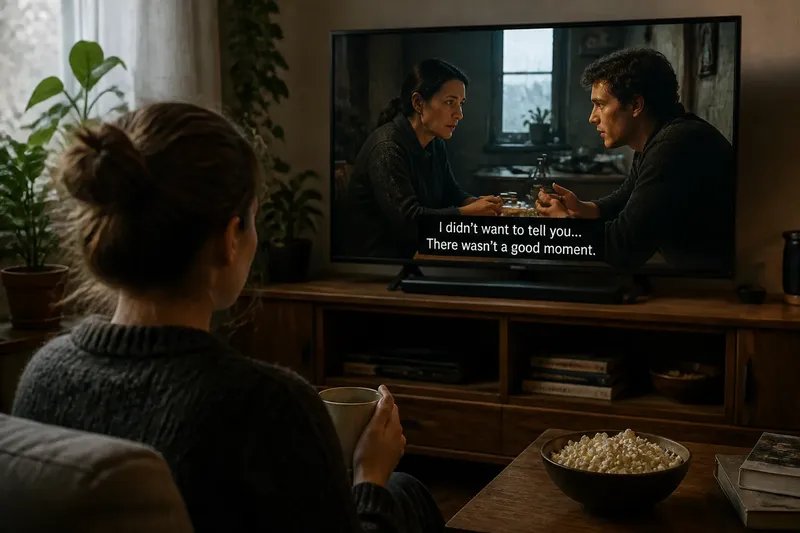
When you choose subtitles or dubbing for a film from another language, you are choosing how its voices reach you. Subtitles keep the original speech audible while adding written translation; dubbing replaces that speech with recorded voices in another language. Each carries meaning across a linguistic border, but each also changes the viewing experience in a different way.
A simple way to understand those differences is to compare versions during an ordinary week, using one film available in both forms. You do not need to know the source language or judge which translation is “right.” Listen for what remains audible, watch how performances change, and notice what your attention is asked to do. The aim is not to declare a winner. It is to make a deliberate choice for the film and the moment.
Before you press play
Start by checking which versions are actually available. A streaming menu may offer subtitles in several languages but dubbing in only one, or the reverse. Disc releases, festival screenings and television broadcasts can differ too. Look for separate options such as “subtitles,” “captions,” “audio” and “language.” Captions may include sound cues and speaker identification, while subtitles often focus on spoken dialogue; menus do not always use these labels consistently.
Choose a film with enough quiet to pay attention. A conversation scene is useful because it gives you faces, pauses and dialogue to notice without relying on action to hold your interest. If the film has a scene with several speakers, that can help you observe how each version handles rapid exchanges. Avoid starting with a scene so dense with names or specialist terms that translation choices become hard to follow.
Set a modest question before watching. For example: “What do I notice about the original voices?” or “Does the dubbed dialogue sound comfortable with the actors’ faces?” One question is enough. Trying to monitor every translation decision can turn a film into homework and crowd out the story.
Subtitles and the audible original
Subtitles let you hear the original actors, including qualities that words alone do not convey. A voice may turn sharp, soften at the end of a sentence or hesitate before answering. You can hear how a character’s delivery changes while reading a translation. In films from Eastern Europe, where one production may bring together several languages or accents, that sound can also help distinguish relationships and social settings.
The trade-off is divided attention. Your eyes move between the text and the image, and you may miss a glance or a gesture while reading a line. Subtitles also have to fit on screen for a limited time, so dialogue may be shortened or phrased more compactly than the speech you hear. A long, tangled sentence can become a brief, readable line; that helps the scene move, but some texture may disappear.
Try subtitles when the actors’ vocal performances matter to you, or when the film’s original soundscape is central to its effect. They can also be useful if you want to hear the source language without needing to understand it. You may still notice rhythm, repeated words or the contrast between a formal voice and an intimate one, even when the translation carries the plot.
Do not treat every mismatch between speech and text as an error. Translation involves choices about length, tone and context. A compact subtitle may express the point of an exchange without reproducing every word. If a line seems surprising, keep watching for clues in the response and the scene rather than stopping at each sentence.
Dubbing and the translated voice
Dubbing places translated dialogue in the audience’s language, so you can follow speech without reading on-screen text. That can keep your gaze on faces, movement and the setting. It may be the more comfortable choice when you are tired, watching from a distance or sharing the film with someone who finds subtitles difficult to read.
It also gives the translated voice a direct role in performance. The new actor must convey emotion, pace and character while fitting the scene’s timing. A line can feel natural in the target language but sound different from the original actor’s delivery. The spoken translation may also shift a character’s apparent age, authority or warmth, even though the image has not changed.
Dubbing can make a film easier to follow, but it does not make translation disappear. The dialogue still has to carry the story in another language, and the replacement performance becomes part of how you experience the characters. If several original voices are distinct, listen for whether the dubbed version gives them equally distinct patterns, or smooths them into a more uniform sound.
When a film mixes languages, dubbing can alter the contrast between them. If a character switches from one language to another, the translated version may preserve that switch, render both in the same language or signal the change through a different voice or phrasing. The choice affects how readily you hear a boundary between speakers. The exact approach depends on the version you are watching.
A week of close viewing
Give the comparison a few short sessions rather than trying to inspect two complete versions in one sitting. A week leaves room to watch normally, return to a brief scene and let each version stand on its own. Use the same film, the same available language options and the same scene where possible. Do not pause to write down every line; a few notes after each viewing are enough.
- First evening: Watch a short scene with subtitles. Follow the story, but notice when your eyes leave the actors and whether the original voices add something the text does not carry.
- Next day: Watch the same scene dubbed. Pay attention to the voice performances, the fit between speech and facial movement, and whether you can stay with expressions more easily.
- Midweek: Watch a different scene in whichever version you have not yet considered closely. Choose a moment with silence, overlapping dialogue or a change of mood, then note what each form makes easiest to notice.
- Later in the week: Watch a longer stretch in your preferred version without pausing. Ask whether the translation lets you follow the relationships and whether the film’s pace feels intact.
- At the end: Return to one brief exchange in both forms. Decide which version suits this film for you, then watch the rest without switching back and forth.
Say you choose an imagined scene in which a woman asks her brother a brief question, then waits through an uneasy silence. In the subtitle version, you may hear the original pause and read a compact question while watching her face. In the dubbed version, you may follow her expression without reading, while the translated voice shapes the question’s tone. After comparing them, you might choose subtitles because the silence and original voices matter most to you, or dubbing because the exchange is easier to follow as dialogue. Either choice gives you a clear reason, not a verdict about translation quality.
Keep notes to observations rather than scores: “the joke was shorter,” “the pause remained audible,” or “the two speakers sounded more alike.” Those details help you remember why one version suited the scene. A rating system, a line-by-line transcript or repeated rewinding is not worth the effort for a casual viewing; it can make small differences seem more important than the film itself.
Which version suits you?
Do subtitles change the original performance?
They leave the original voices audible, so the actors’ vocal performances remain part of the soundtrack. The written translation can still affect how you interpret the scene, and reading may pull your gaze away from small visual details.
Does dubbing match the actors’ mouths?
Dubbing is timed to the filmed dialogue, but a translated line may not match every visible mouth movement perfectly. The result depends on the scene and the language choices, so judge the whole performance rather than one syllable.
Which version is easier to follow?
Subtitles suit viewers who are comfortable reading while watching and want to hear the original voices. Dubbing may be easier when reading is tiring or when you want to keep your eyes on the image; personal preference and the film both matter.
Can subtitles include sounds as well as dialogue?
Some captions include cues for music, off-screen sounds and speaker changes, while dialogue subtitles may include little beyond speech. Check the available options in the player if those cues would help you understand the scene.
Choose for the film
Make the final choice by asking what you want to notice. Choose subtitles if you value the original voices, accents and speech rhythms, and are comfortable sharing your attention between text and image. Choose dubbing if hearing dialogue in your language helps you stay with the acting and visual details. If the film depends on switching among languages, consider which version makes those changes clearest to you.
If you watch with someone else, agree on the version before the film begins. A brief conversation about reading comfort, voice preference or the reason for watching is more useful than assuming one option is the proper way to see a foreign-language film. For language learners, the decision can vary by evening: subtitles offer a chance to hear the source speech, while dubbing lets you concentrate on the translation without reading.
For a film crossing linguistic borders, subtitles and dubbing are not invisible containers. Subtitles bring translated words alongside an audible performance; dubbing gives translated words a new voice. Use subtitles or dubbing according to the details you want closest: the original sound, the translated spoken line, or the image. That choice is a small but practical part of meeting a film on its own terms.